

New Global Study Warns Maritime Workforce is not Keeping Pace with Digital Change
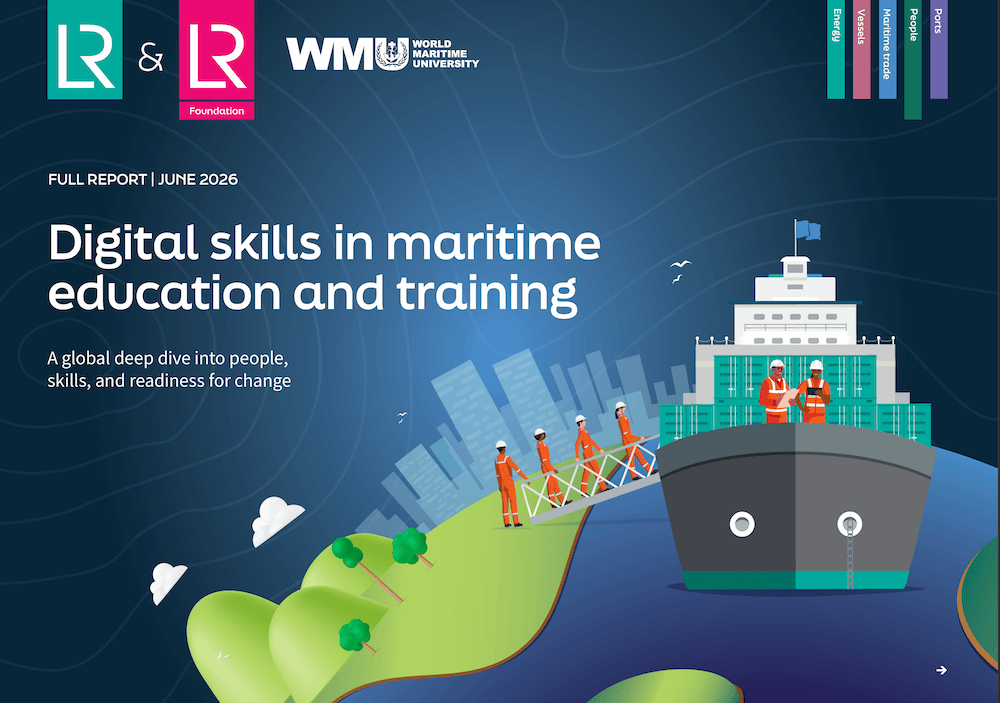
Report calls for urgent action on training, regulation and investment.
A major international study launched on 25 June, Day of the Seafarer, has found that the maritime workforce is not keeping pace with the rapid adoption of digital technologies, raising concerns for safety, efficiency and long‑term sustainability.
The report, “Digital skills in maritime education and training: A global deep dive into people, skills, and readiness for change”, was written by the World Maritime University (WMU) and commissioned by Lloyd’s Register Foundation through the Global Maritime Trends programme. It draws on a survey of 532 seafarers across 64 countries and interviews with 110 stakeholders.
It highlights a growing gap between technological change and the sector’s ability to use new systems effectively and safely. Digital tools - from automated navigation to data‑driven decision‑making - are already reshaping operations, but training and certification frameworks are not evolving at the same pace.
More than 80% of seafarers report receiving digital skills training rarely or not at all, despite strong appetite to learn. Two‑thirds say they are willing to upskill, but a lack of shared understanding of what “digital skills” means is holding back progress.
Seafarers report confidence in traditional systems but feel far less prepared to work with automation and data‑intensive tools. Just 13% say shore‑based training consistently matches the systems they encounter onboard.
Maritime education providers are responding, but progress remains uneven. Many face barriers including limited funding, a shortage of digitally skilled instructors and slow‑moving regulation. The report also warns that digital transformation could deepen global inequalities, as access to training depend son resources and investment.
Findings from the Global Maritime Trends Digital Transition Barometer also point to the same challenge. Its People pillar – which tracks workforce skills, training and readiness for change – has increased by six points to 38%, but remains one of the weakest areas of the transition, highlighting the risk that technology is advancing faster than the people needed to use it safely and effectively.
Dr Jan Przydatek, Director of Technologies at Lloyd’s Register Foundation, said: “Digitalisation is changing how people work and how risks are managed. If we don’t invest in people alongside technology, we risk creating new safety challenges rather than solving existing ones. This research shows that gaps in digital skills have real implications for safety. Closing them means making sure seafarers have the confidence and capability to operate in an increasingly digital environment.”
Mark Warner, Global Client Marketing Director at Lloyd’s Register, said: “Technology adoption is moving faster than training standards, instructor capability and certification frameworks. In many cases, innovation is outpacing preparedness. Technology only improves safety when people understand how systems work, trust their outputs, and know when not to rely on them. As digital tools become part of everyday operations, human judgement and confidence remain essential.”
Professor Maximo Q. Mejia, Jr., President of the World Maritime University, said: “Maritime digitalisation is no longer a future possibility - it is already shaping how ships are designed, operated and regulated. The question is whether the workforce is ready. Achieving the benefits of this transition depends on people having the skills and confidence to use digital tools effectively.”
The report calls for coordinated action across the sector, including faster updates to global training standards, greater investment in education, and stronger collaboration between industry, regulators and training providers.
To find out more and read the report visit: Global Maritime Trends | LR
About the Global Maritime Trends Programme
The Global Maritime Trends programme launched by Lloyd’s Register and Lloyd’s Register Foundation, is a dynamic, multi-year research initiative, designed to provide evidence, insight, and foresight into the major challenges shaping the maritime industry between now and 2050, taking a holistic view of the maritime world, from fishing to offshore wind.
The programme launched in 2023 with the Global Maritime Trends 2050 Report (GMT2050 Report) by Economist Impact, which analyses possible future scenarios for maritime in 2050, based on the speed of technology adoption and the level of global collaboration, to help the industry forecast risks, opportunities, and required investment.
At the heart of the programme are a series of 'deep dive' reports which explore critical maritime issues, delivering expert analysis and robust data to provide a comprehensive understanding of the evolving maritime landscape and the potential implications for various maritime stakeholders.
In parallel with those deep dives and part of that same programme is the Global Maritime Trends Barometer which offers an annual pulse of the maritime industry’s journey through the energy transition and digital transition, while assessing progress towards the four future scenarios as outlined in the GMT2050 Report by Economist Impact. The Barometer is structured along five key components of the maritime industry: maritime trade, energy, vessels, ports and people. Global MaritimeTrends | LR


