

SEA-CARE Sector-Wide Survey to Strengthen Crisis Response at Sea
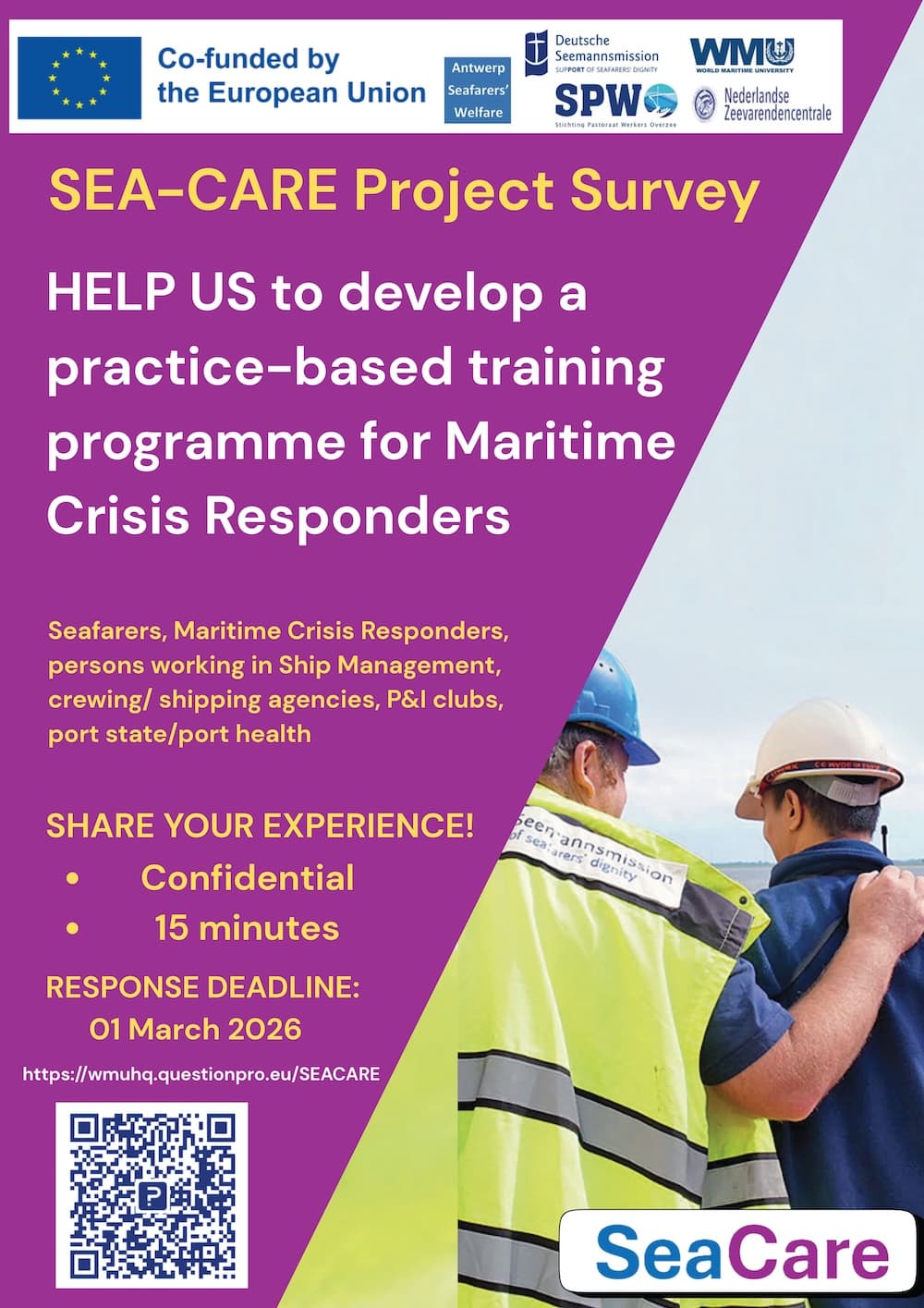
A new ERASMUS programme – supported initiative, SEA-CARE, has officially been launched with the World Maritime University (WMU) as a partner. The project brings together five maritime welfare-focused organizations from Western Europe with a shared goal of strengthening the skills and capacities of professionals who provide psychological support to seafarers affected by serious onboard incidents.
Serious incidents at sea—such as accidents, fatalities, piracy, or other traumatic events—can have long-lasting psychological effects on those involved. Seafarers, shipowners, and authorities often lack immediate access to trained mental health support when such incidents occur. SEA-CARE addresses this gap by working to establish a robust, cross-border network of trained Maritime Crisis Responders who can provide timely and professional support during and after critical incidents.
Within the project, WMU is contributing academic and pedagogical expertise to develop a dedicated education and training programme. The programme will be grounded in the extensive practical experience of the project’s partner organizations and translated into structured learning content aimed at improving the quality, consistency, and effectiveness of psychological support provided to seafarers following traumatic maritime incidents.
SEA-CARE Survey
As a first and essential step, the SEA-CARE project has launched a sector-wide survey. The survey aims to gather insights into current experiences, needs, and challenges related to incident response and mental-health support in the maritime industry.
The survey is being distributed widely among seafarers, shipowners, maritime officials, and other stakeholders who may be involved in or affected by serious onboard incidents. Their perspectives are vital to ensuring that future crisis-response training and support systems are practical, effective, and aligned with real-world needs.
Everyone Can Help
SEA-CARE emphasizes that everyone in the maritime sector can contribute to improving crisis response and mental-health support at sea. By completing the survey, participants directly support the development of better structures, training, and cooperation across Western Europe.
The survey is open until 1 March 2026, to allow for broad participation across the sector.
Project Partners
The SEA-CARE project brings together five maritime welfare-focused organizations from Western Europe. Deutsche Seemannsmission e.V.(DSM), serves as the project lead. The additional project partners include - Antwerp Seafarers’ Welfare (ASW), Stichting Pastoraat Werkers Overzee (SPWO), Nedelandse Zeevarenden Centrale (NZC), and World Maritime University (WMU).
SEA-CARE (Agreement No. 2025-1DE02-KA210-VET-000356737) is funded by the European Union. Views and opinions expressed are those of the author(s) only and do not necessarily reflect those of the European Union or the European Education and Culture Executive Agency (EACEA). Neither the European Union nor EACEA can be held responsible for them.
To access the survey, click here.


