

WMU Co-Hosts High-Level Roundtable Seminar as BBNJ Agreement Enters into Force
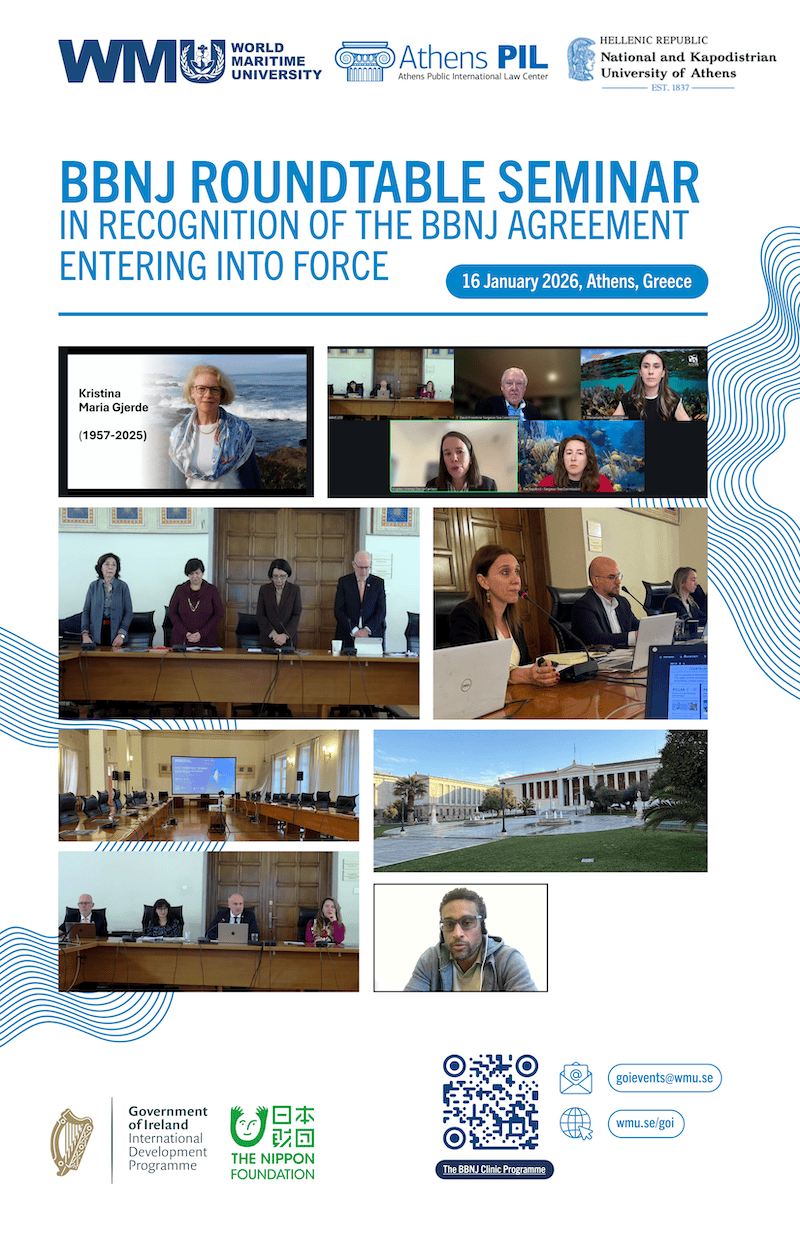
On 16 January, the World Maritime University–Sasakawa Global Ocean Institute (WMU-GOI) co-hosted a hybrid BBNJ Roundtable Seminar in Athens, Greece, marking the entry into force of the Agreement under the United Nations Convention on the Law of the Sea on the Conservation and Sustainable Use of Marine Biological Diversity of Areas beyond National Jurisdiction (BBNJ Agreement).
The onsite event was hosted by the Athens Public International Law Center (Athens-PIL), operating within the Faculty of Law of the National and Kapodistrian University of Athens (NKUA), within the framework of WMU’s Ireland–WMU-GOI BBNJ Clinic Programme. The roundtable convened more than experts—including academics, international lawyers, scientists, representatives of government and international organizations, as well as leaders from the ocean, finance, and environmental sectors— as panelists and discussants to reflect on the significance of the Agreement and examine pathways for its effective implementation.
Adopted on 19 June 2023 under the auspices of the United Nations, the BBNJ Agreement is the third implementing agreement to the United Nations Convention on the Law of the Sea. With 83 ratifications to date, the Agreement entered into force on 17 January 2026, representing a major milestone in global ocean governance and the protection of Marine Biodiversity Beyond National Jurisdiction.
The seminar programme was opened by Professor Photini Pazartzis, Director of Athens PIL, who invited the audience for a minute of silence in honourable memory of the late Dr. Kristina Maria Gjerde (1957-2025), widely known as the “Mother of the High Seas” and a leading advocate for deep-ocean protection. Her vision and dedication were widely acknowledged as instrumental in advancing the BBNJ process, with the Agreement’s entry into force standing as a lasting testament to her legacy.
Welcome remarks by Professor Ronán Long, Director of the WMU-GOI,and Professor Maria Gavouneli, Deputy Director of the Athens PIL, emphasized the importance of the Agreement for the ocean and the efforts by states, non-states, experts and civil society in its implementation. The Seminar Keynote was delivered by Maria Damanaki, Independent Advisor on Climate-Oceans, Former European Commissioner for the Environment, Oceans and Fisheries, Greece.
Panel discussions centered on the creation and interpretation of the Agreement, with particular attention to the Mediterranean context, the role of non-parties and adjacent States, and preparations for the first Conference of the Parties. Panelists also explored practical implementation challenges, including the use of area-based management tools and Particularly Sensitive Sea Areas, as well as the importance of ocean technology transfer and capacity development, especially for Small Island Developing States.
WMU-GOI experts contributed to the programme including, Assistant Professor Aspasia Pastra, and Senior Postdoctoral Researchers Dr. Mariamalia Rodríguez Chaves and Dr. Kahlil Hassanali, who participated in panel discussions addressing key legal, scientific, and governance aspects of the Agreement’s implementation and future outlook. WMU Professor George Theocharidis chaired the panel on Area Based Management Tools.
The Seminar attracted global interest with more than 235 registered participants from more than 85 countries and a gender distribution of 59 % female and 41 % male.
More information about the BBNJ Agreement and the Seminar, including post-event material, can be found on the BBNJ Clinic website.
About Athens PIL
The Athens Public International Law Center (Athens PIL), founded in July 2015 and operating within the Faculty of Law of the National and Kapodistrian University of Athens, is an academic research institution dedicated to the study and promotion of international law, including in particular the law of the sea. Its mission focuses on advancing international law through teaching, research, and scholarly activities, fostering an international academic community, and contributing to the development of international law through seminars, conferences, training programmes, and cooperation with academic institutions and international organizations worldwide.
About WMU-GOI
The World Maritime University (WMU)–Sasakawa Global Ocean Institute (GOI), was founded in May 2018, and engages at the interdisciplinary interface between science, policy, and law to address contemporary challenges in ocean governance and the Law of the Sea. Faculty, staff and students at the Institute undertake evidence-based research, as well as educational and capacity development training, with a focus on the United Nations Sustainable Development Goals, in particular, Goal 14 - Life Below Water. The work is funded and supported by The Nippon Foundation, as well as by Sweden, Ireland, Germany, Canada, the European Commission, the City of Malmö, and other partners.
About the BBNJ Clinic Programme
Funded by Ireland, the BBNJ Clinic Programme is implemented by the WMU-GOI with the aim to assist Small Island Developing States (SIDS) and Least Developed Countries (LDCs) in ratifying and implementing the Agreement under the United Nations Convention on the Law of the Sea on the Conservation and Sustainable Use of Marine Biological Diversity of Areas beyond National Jurisdiction (BBNJ Agreement)BBNJ Agreement. The Clinic offers legal and policy support to ensure inclusive participation in ocean governance.


